
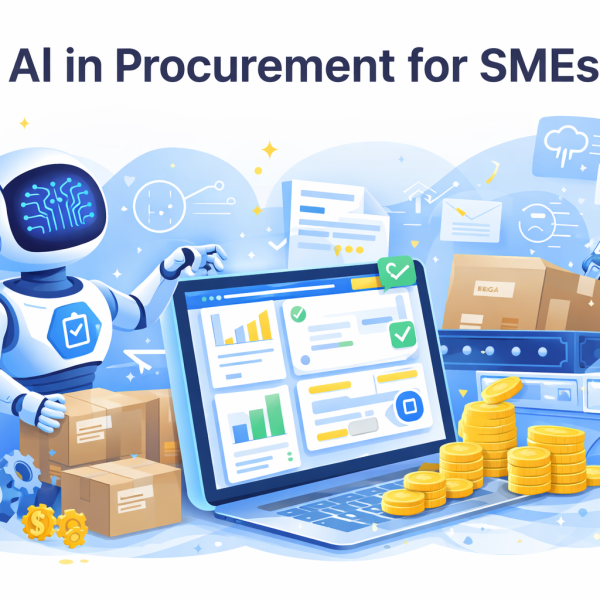
AI in Procurement for SMEs
How Small & Medium Businesses Can Eliminate Manual Supplier Chaos
For many small and medium-sized businesses (SMEs), procurement is still handled through email threads, spreadsheets, and manual follow-ups.
While enterprise companies invest in ERP systems, most SMEs operate with:
- Gmail inboxes full of supplier replies
- Excel sheets tracking product lists
- Manual copy-paste into purchase orders
- No visibility into who replied and what was agreed
This creates operational friction that directly impacts margins, lead times, and internal productivity.
AI-driven procurement automation is no longer reserved for large corporations. Today, SMEs can deploy lightweight automation layers without replacing their existing systems.
The Real Problem in SME Procurement
Procurement inefficiencies in SMEs usually come from:
- Email-based supplier communication
- Manual reconciliation of quotes
- Lack of structured data
- Human error in pricing and quantities
- No audit trail
According to research from McKinsey on digital procurement transformation, automation reduces processing costs by 30–50% and significantly improves cycle time.
(Source: McKinsey & Company – Digital Procurement Insights)
But most SME owners don’t need a full ERP migration.
They need:
- Structure
- Visibility
- Fewer mistakes
- Faster ordering
Where AI Actually Helps (Without ERP Replacement)
AI in SME procurement does not mean predictive neural networks forecasting commodities.
It means:
- Structuring Unstructured Emails
Supplier replies become structured decision data.
- Automated Purchase Order Generation
Instead of manually rewriting email replies, systems generate formatted POs.
- Validation & Error Detection
AI-assisted validation detects:
- Missing fields
- Duplicate suppliers
- Incorrect pricing
- Decision Tracking
From request → reply → decision → next action.
This closes the procurement loop.
The ROI for SMEs
Typical impact areas:
- Faster order cycles
- Fewer pricing mistakes
- Clear supplier accountability
- Reduced internal admin hours
Even saving 5–8 hours per week per operations employee creates measurable cost efficiency.
Why Structured Data Matters
AI cannot operate on chaotic spreadsheets.
Procurement automation requires:
- Standardized supplier data
- Standardized product lists
- Clean CSV structure
This is why structured imports are critical.
For businesses starting without ERP systems, a lightweight structured CSV foundation is often the most pragmatic first step.
Implementation Strategy for SMEs
Step 1: Structure supplier & product lists
Step 2: Centralize communication
Step 3: Add automation layer
Step 4: Measure cycle time reduction
No heavy ERP migration required.
Final Thought
Procurement AI for SMEs is not about complexity.
It’s about reducing friction.
Automation should remove repetitive administrative work — not introduce new systems that overwhelm teams.